
Social Proof
Using other people's visible choices or evaluations as one input—especially when a decision feels uncertain.
In one sentence
Social proof is a practitioner label for designs that show what other people did, chose or rated. The underlying processes are forms of social influence: people may treat others' behaviour as information about what is useful, or may feel pressure to align with a group. A count, ranking, review or testimonial can therefore affect attention and choice, but popularity is not the same as quality, suitability or truth.
Try this in practice
Make the idea useful.
Use these as hypotheses to test in your own product and context—not as predictions about what people will do.
- Show only genuine, relevant social evidence. State what the signal counts, its population or geography, its time window and—where useful—its sample size. Disclose sponsorship and verification, let people inspect the underlying reviews, and never fabricate, seed or selectively hide activity.
- Use other people's behaviour as optional information, not a command. Avoid “everyone” or “people like you” unless the reference group is defined. Keep an independent route to choose, protect minority and low-volume options from automatic exclusion, and remember that popularity ranking can amplify the popularity it displays.
- Compare the social signal with a clear no-signal or differently explained version. Test whether people understand what it means and measure confidence, fit, decision quality, regret, returns, complaints and diversity of exposure—not conversion alone. Stop or revise it if people mistake popularity for quality, feel pressured, or move towards an unwanted norm.
- Use it when
- Gives users additional evidence when outcomes are hard to judge, and can make unfamiliar options easier to compare when the signal is genuine, relevant and clearly defined.
- Watch for
- Early activity can snowball into higher visibility and ratings, making popularity partly self-reinforcing. Broad or stale counts can mislead; majority cues may suppress minority preferences, create pressure or increase an unwanted behaviour.
Seen in real products
How teams put it to work.
Examples identified in our interface teardowns, linked back to the full product journey.

A 56k follower count presents other people’s interest as information about the collection. The number lacks a time period, denominator and explanation of what following represents.
View Help people find the right show →
Amazon labels a bundle “Frequently bought together” and shows review counts on suggested books. These are visible signals of other customers’ behaviour and evaluation; purchase frequency does not establish compatibility, suitability or better value.
View Explain why products appear →
A home-feed card shows “422 meditating” with small avatars. This is an explicit activity-count cue; its time window, geography and method are not defined, and simultaneous use does not establish that the content suits this person.
View Keep wellbeing and selling separate →
The home promotion says “Most-loved travel essentials” and “Highly-rated by customers”. These are explicit popularity and evaluation cues; the screenshot does not define the ranking population or show that the products are suitable for this person.
View Explain why products appear →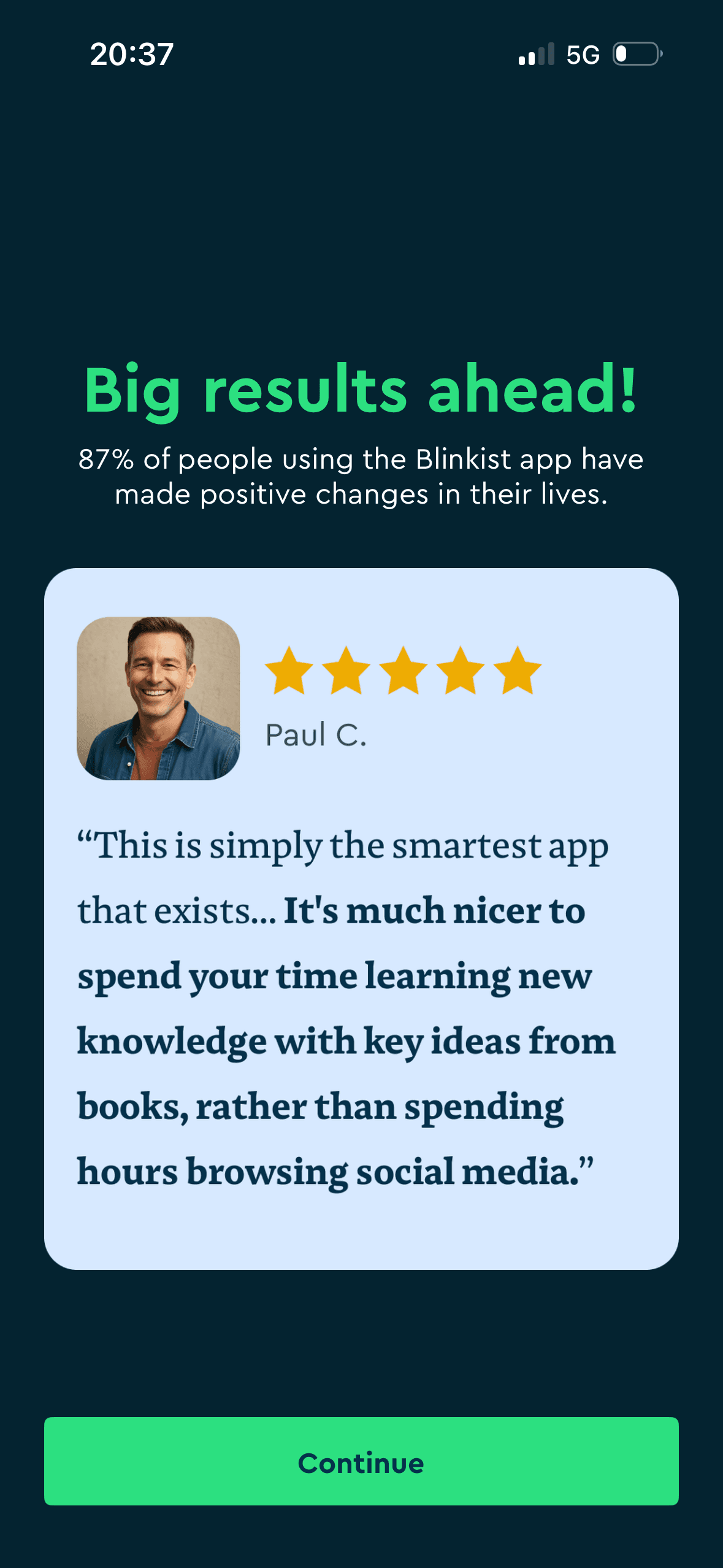
Blinkist pairs an “87% of people” positive-change statement with a named five-star testimonial. These are social-evidence cues, but the internal survey method and review source are absent and neither establishes that Blinkist caused the reported outcome.
View Personalise before asking for payment →
Ratings, review counts or popularity labels provide social evidence, but the screen does not always define the audience, time window or sample behind them. Popularity should not be read as universal quality or fit.
View Build momentum without pressure →Current interpretation
What this may help explain.
A 2006 online experiment by Matthew Salganik, Peter Dodds and Duncan Watts created an artificial music market with 14,341 participants and 48 previously unknown songs. Participants either chose without seeing earlier downloads or entered one of eight separate social-influence “worlds” that displayed download counts. In the first experiment songs remained in random positions; in the second they were also ranked by current downloads, making the popularity signal more prominent.
Showing earlier downloads made success more unequal and less predictable across otherwise comparable worlds, and the stronger ranked signal increased both patterns. Quality still mattered at the extremes, but popularity was not a clean measure of it. Two later field experiments show why the design details matter. In 2007, descriptive neighbourhood feedback reduced electricity use among above-average households but increased it among below-average households; adding approval for low use removed that boomerang effect. In 2013, one randomly assigned up-vote among 101,281 online comments made the next viewer 32% more likely to up-vote and raised final ratings by 25% on average, while negative manipulation was corrected and effects varied by topic and relationship.
Use this as a starting point for a hypothesis, then check it with your own users and context.
Source check
What this guidance is based on.
3 sources have been checked by The UXologist. Findings and limitations are shown together so you can judge how well they fit your situation.
Social Influence Bias: A Randomized Experiment
Research-assisted source review
- What it supports
- A random initial up-vote increased the next viewer's probability of up-voting by 32% and produced final mean ratings 25% above control. A random down-vote attracted both more down-votes and a larger corrective increase in up-votes, leaving final ratings indistinguishable from control. Positive herding varied across topics and social relationships.
- Who or what was studied
- 101,281 comments on one social news aggregation site were included over five months. They received more than 10 million views and 308,515 subsequent ratings; users could appear repeatedly.
- Study setting
- Comments were randomly assigned to receive an artificial initial up-vote, an artificial initial down-vote or no vote. The site showed current scores but did not order comments by popularity, helping isolate how the displayed rating affected later voting.
- Where it may not transfer
- The experiment involved comments and net vote scores on one unnamed community with a natural tendency to up-vote; it does not establish effects for product ratings, purchases or every population. The asymmetry and topic differences limit simple generalisation. Artificially seeding a live rating is deceptive and is evidence about risk, not a recommended design tactic.
The Constructive, Destructive, and Reconstructive Power of Social Norms
Research-assisted source review
- What it supports
- Descriptive feedback alone reduced daily use by 1.22 kWh among 64 above-average households but increased it by 0.89 kWh among 79 below-average households. Adding approval for below-average use removed that increase; above-average households also reduced use with the combined message. The broad pattern remained at the later follow-up.
- Who or what was studied
- 290 households with publicly visible electricity meters in three census-block groups in San Marcos, California, were recruited under an opt-out protocol; three withdrew, leaving 287.
- Study setting
- After baseline meter readings, matched households were randomly assigned to receive descriptive feedback about their usage and the neighbourhood average, or the same feedback plus a hand-drawn approval or disapproval face. Researchers measured short- and longer-term actual electricity use.
- Where it may not transfer
- This was one community and a recurring, private behaviour with direct financial and socially approved benefits. Forty-one households whose relative position changed were excluded from the longer-term subgroup analysis. A popularity label in a shopping or content interface may not reproduce the effect, and approval or disapproval can introduce pressure that requires its own ethical review.
Experimental Study of Inequality and Unpredictability in an Artificial Cultural Market
Research-assisted source review
- What it supports
- Every social-influence world produced greater inequality of downloads than independent choice, and success varied more between the eight otherwise comparable worlds. Ranking by download count strengthened both inequality and unpredictability. The best songs rarely did poorly and the worst rarely did well, but outcomes for the rest were only partly determined by quality.
- Who or what was studied
- 14,341 online participants evaluated and could download 48 previously unknown songs in two artificial music-market experiments.
- Study setting
- Participants were randomly assigned either to an independent condition with no prior download information or to one of eight separate social-influence worlds. Social worlds displayed download counts; the second experiment also ranked songs by those counts, strengthening the signal. The independent condition supplied a behavioural estimate of song quality.
- Where it may not transfer
- This was an artificial market for free downloads of unfamiliar music among a particular online volunteer population. Download choice is not a high-stakes decision, and “quality” was inferred from choices in the independent condition rather than an external standard. The study shows path dependence, not that every popularity cue has the same effect.