
Peak-End Rule
People may remember an experience through its most intense moment and how it ended—not its full duration.
In one sentence
The peak–end rule describes a pattern in retrospective evaluation: when people look back on an experience, its most emotionally intense moment and its ending can carry disproportionate weight. It concerns how an experience is remembered, not necessarily how good the complete experience was while it happened. The overall average can matter just as much, so this is not a licence to neglect the rest of a journey.
Try this in practice
Make the idea useful.
Use these as hypotheses to test in your own product and context—not as predictions about what people will do.
- Improve the whole journey first. Track effort, errors, abandonment and wellbeing across the experience—not only satisfaction measured after it ends.
- Treat important moments and endings as memory checkpoints. Make high-stakes steps clear and recoverable, then close with an honest summary, saved progress and a useful next step.
- Test memory separately from lived experience. Compare in-the-moment feedback with later recall, and stop if an improved ending hides earlier harm, added friction or unresolved problems.
- Use it when
- Helps teams understand why later satisfaction or willingness to return can differ from what people experienced moment by moment.
- Watch for
- A memorable peak or ending can be mistaken for proof that the whole journey was good. Effects depend on context, and retrospective ratings can hide sustained friction or harm.
Seen in real products
How teams put it to work.
Examples identified in our interface teardowns, linked back to the full product journey.

The final captured screen repeats selected artists with “Great picks!”. It creates a distinct ending cue that could be tested as a peak-end hypothesis, but the screenshot does not show later memory, satisfaction or retention.
View Show value before more setup →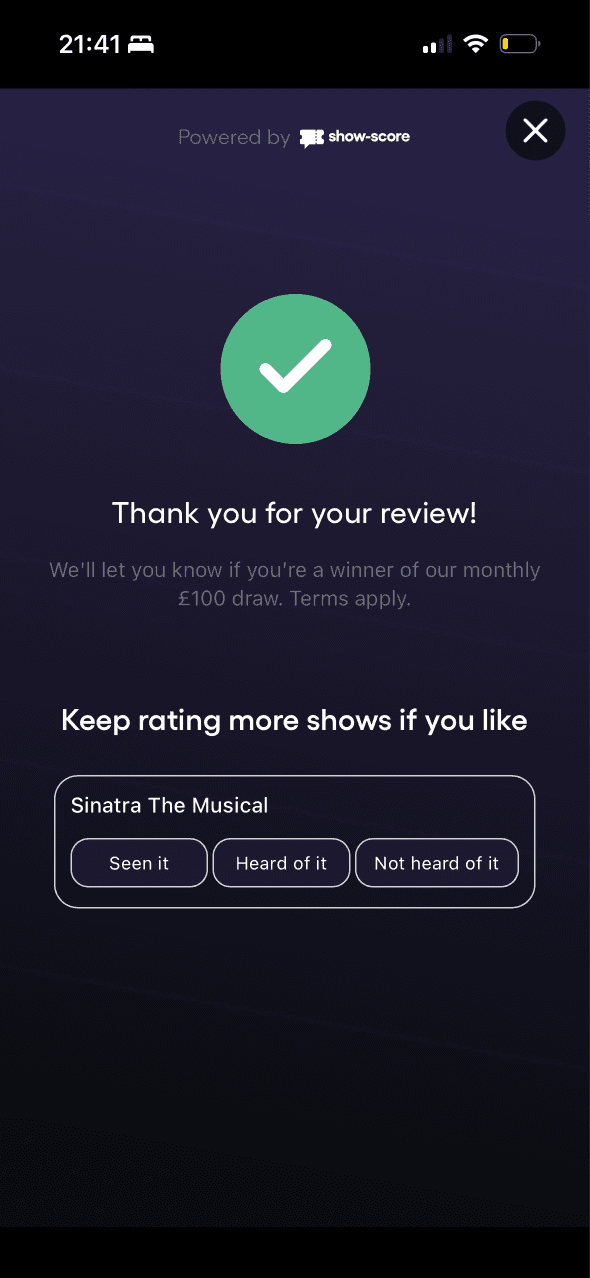
The final screen pairs successful completion with another optional rating task. This ending may colour recall of the journey, but its effect on satisfaction is not demonstrated.
View Ask for feedback without overreaching →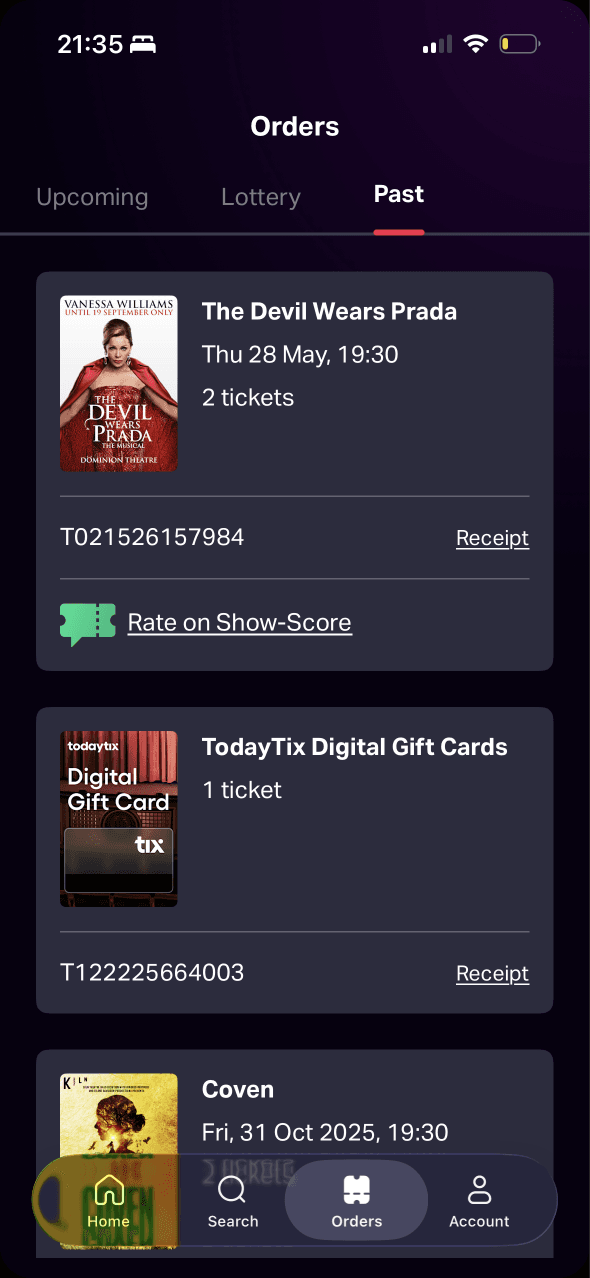
The review request appears after the attended event, encouraging a later overall judgement that may be shaped most strongly by memorable peaks and the ending.
View Ask for feedback without overreaching →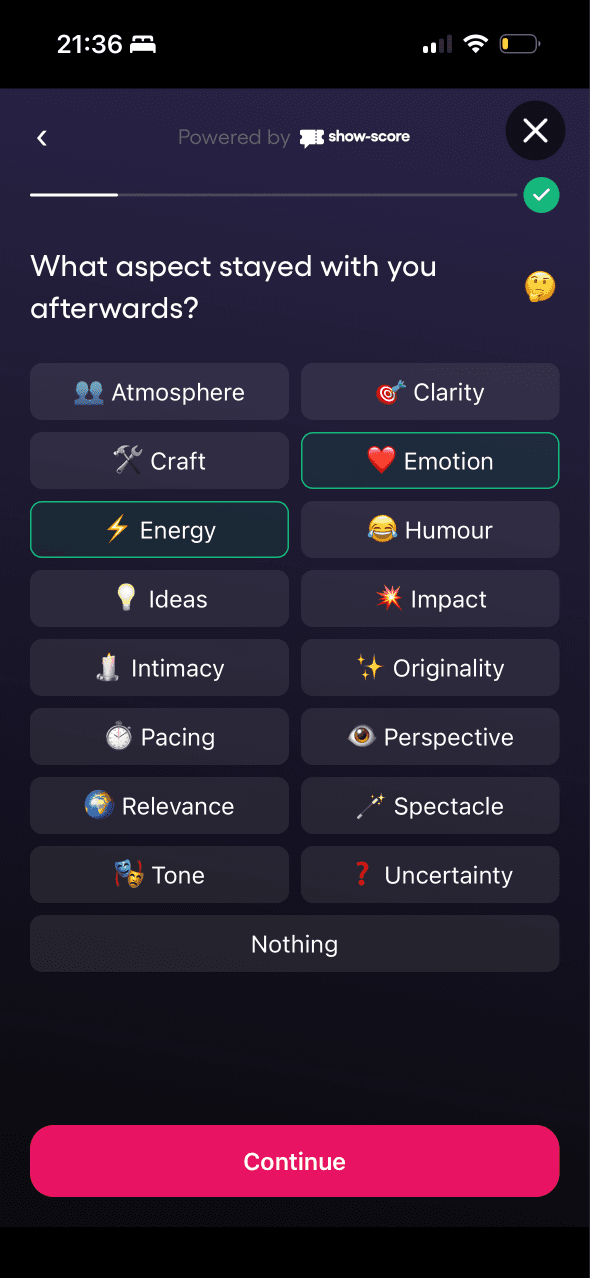
Asking what stayed with someone after separate like and dislike prompts may favour the most intense or recent parts of the show over a fuller account of the experience.
View Ask for feedback without overreaching →
The journey ends with a clear completion state and next action, giving the flow a distinct final moment. That ending should confirm what changed rather than manufacture praise.
View Build momentum without pressure →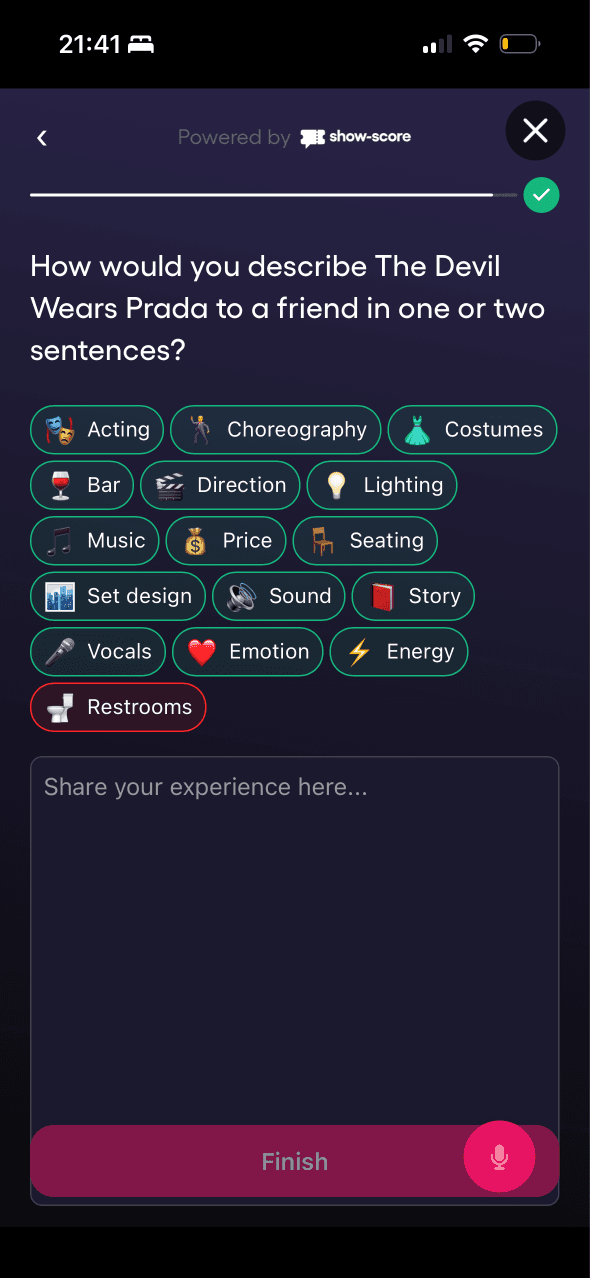
The writing task comes near the end of a long survey, so the most recent research questions may influence the final account more than the show experience itself.
View Ask for feedback without overreaching →Current interpretation
What this may help explain.
In a 1993 experiment, 32 male university students completed two painful cold-water trials. In the short trial, one hand stayed in water at about 14°C for 60 seconds. In the long trial, the other hand stayed at the same temperature for 60 seconds, then remained for another 30 seconds while the water warmed to about 15°C. The extra period was still uncomfortable but ended less painfully for most participants. They were then asked which trial they would rather repeat.
Twenty-two of 32 participants (69%) chose to repeat the longer trial, which contained all the pain of the short trial plus 30 extra seconds. A replication reported in the same paper found that 24 of 37 participants also chose the longer trial. This supports the idea that a less unpleasant ending can shape remembered preference, but the study used a small, all-male student sample and a tightly controlled pain task. A 2022 meta-analysis of 174 effect sizes found a large peak–end association with retrospective ratings, but it was comparable with the effect of the overall average. The evidence does not show that every digital journey needs a manufactured “peak”, or that a good ending repairs a poor experience.
Use this as a starting point for a hypothesis, then check it with your own users and context.
Source check
What this guidance is based on.
3 sources have been checked by The UXologist. Findings and limitations are shown together so you can judge how well they fit your situation.
All’s Well That Ends (and Peaks) Well? A Meta-Analysis of the Peak-End Rule and Duration Neglect
Research-assisted source review
- What it supports
- The peak–end effect was large (r = 0.581, 95% CI 0.487–0.661), stronger than duration, beginning and trough effects, and comparable with the effect of the overall average experience.
- Who or what was studied
- A meta-analysis of 174 effect sizes from prior studies of retrospective evaluations.
- Study setting
- Compared peak, end, overall average, duration, beginning, trough, trend and variability as predictors of retrospective summary evaluations of temporally changing experiences.
- Where it may not transfer
- The estimate combines varied study contexts and methods. It concerns retrospective summary ratings rather than all dimensions of user welfare, and its similarity to the overall-average effect means it should not be interpreted as permission to optimise only the peak and ending.
Patients’ Memories of Painful Medical Treatments: Real-Time and Retrospective Evaluations of Two Minimally Invasive Procedures
Research-assisted source review
- What it supports
- Remembered total pain was strongly related to peak pain and pain during the final three minutes. Procedure duration varied substantially but was not associated with a more aversive memory.
- Who or what was studied
- Patients undergoing colonoscopy (154) or lithotripsy (133).
- Study setting
- Patients rated pain during each procedure and later gave a retrospective evaluation of its total pain; the researchers compared those memories with the moment-by-moment record.
- Where it may not transfer
- This was observational evidence from painful medical procedures. The relationships are correlational, the contexts are clinically specific, and the results do not establish how a digital product should sequence an experience.
When More Pain Is Preferred to Less: Adding a Better End
Research-assisted source review
- What it supports
- Twenty-two of 32 participants (69%) chose the longer trial. In the replication, 24 of 37 chose the longer trial. The authors interpreted this as evidence that the less unpleasant ending shaped retrospective preference despite the additional pain.
- Who or what was studied
- Thirty-two male University of California students aged 19 to 39 completed the main experiment; the paper also reports a replication with 37 participants.
- Study setting
- Participants compared a 60-second cold-water trial at about 14°C with a 90-second trial that added 30 seconds of slightly warmer but still uncomfortable water, then chose which trial to repeat.
- Where it may not transfer
- The main sample was small, all male and drawn from university students. The tightly controlled cold-water pain task is far removed from most product experiences, the ending remained unpleasant, and the paper itself raises an informed-consent dilemma about deliberately adding discomfort to improve memory.