
Ask for feedback without overreaching
A “Rate on Show-Score” link beside a past order feels like a small, familiar request. I followed it expecting to rate the show and write a short review. Instead, the journey grew into a much broader survey about the audience, discovery channels, purchase barriers, price, location, other events and performers.
That expansion is the important part of this case study. The questions are generally easy to answer, but the interface does not clearly reset expectations when a review becomes audience research. The £100 prize draw adds another reason to be explicit about length, purpose, data sharing and what is optional.
- Captured
- Capture date not recorded
- Published
- Last updated
- Product version
- TodayTix iOS app; version not recorded
- Source
- View reference ↗
- 16
- Screens
- 18
- Ingredients
- 65
- Applications
Business goals
What works
What the captured flow does well.
- The invitation is tied to the exact show attended.
- Large response choices make most questions easy to scan.
- Positive and negative feedback are collected separately.
- Progress and completion feedback keep the journey moving.
What could improve
What deserves closer review.
- A short review grows into research without a clear handover.
- The progress line does not show how much remains.
- Optional, required and sensitive questions look too similar.
- The prize draw may change who responds and why.
Screen-by-screen breakdown
Follow the journey.
Each observation shows what works or what could improve, on this screen or across the wider flow. The opportunity turns one or two principles into a testable hypothesis.
Screen 01
Past orders
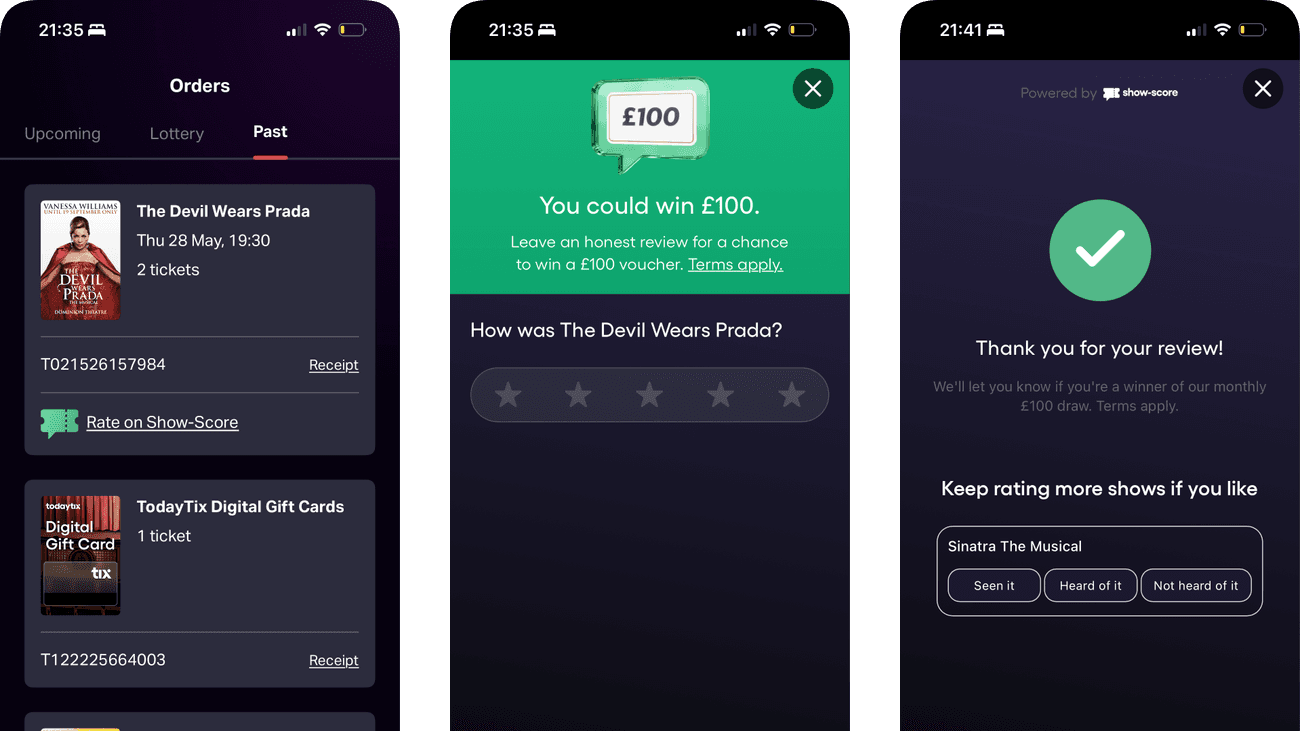
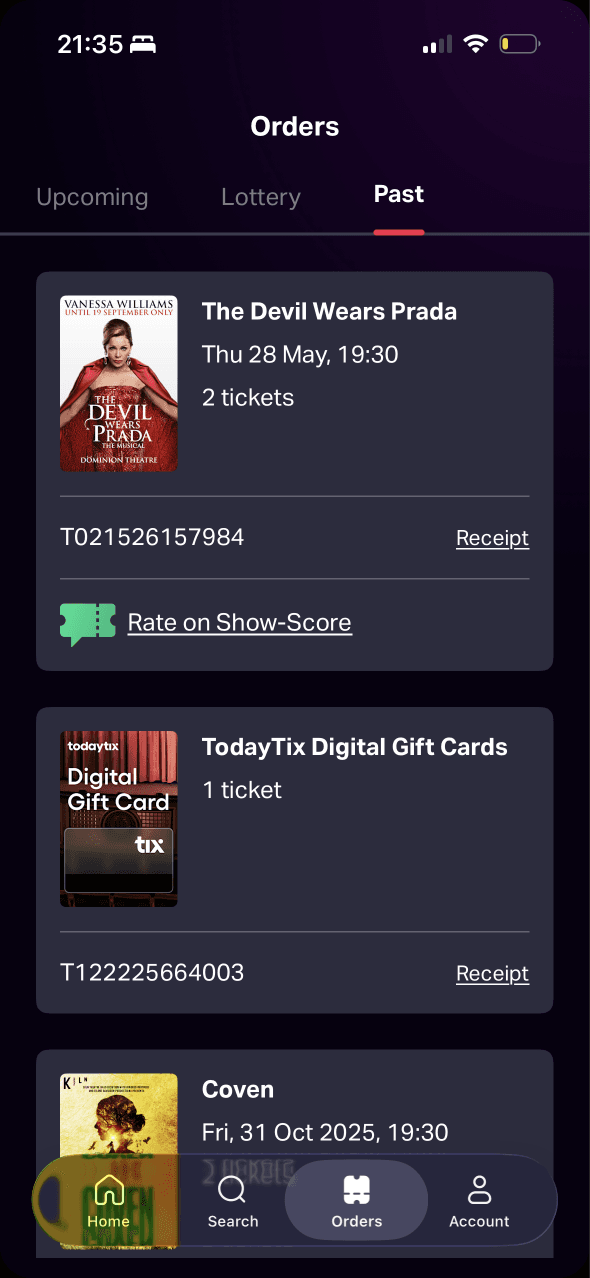
Past orders provide a record of completed purchases, and the review action sits beside the exact production. This creates a clear connection between experience and response.
Rate on Show-Score appears as one action within the past-order card. The label names the provider but does not preview the longer survey that follows.
The review request appears after the attended event, encouraging a later overall judgement that may be shaped most strongly by memorable peaks and the ending.
Show 1 more principleShow fewer principles
The link introduces a rating task but does not preview the broader audience, pricing and location questions that are disclosed only after participation begins.
If TodayTix uses choice architecture and progressive disclosure to preview Show-Score, time and question scope, then people should start with clearer expectations because the destination and effort are known.
Screen 02
Rate the show
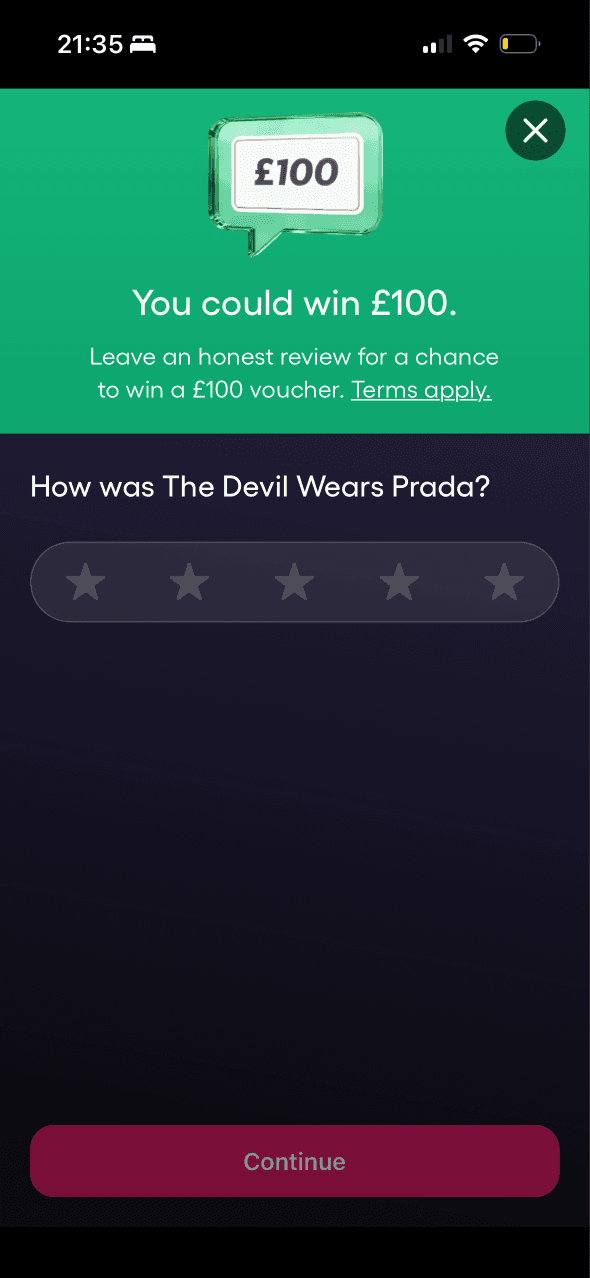
The show name, five-star input, close control and prize terms give the first response a clear structure with a visible way to leave.
A chance to win £100 adds an external reward to a request for an honest review, potentially shifting the reason for taking part from sharing an experience to entering the draw.
You could win and honest review frame participation as both rewarding and socially desirable. Prize terms are available, but the wider research scope is not previewed.
Show 1 more principleShow fewer principles
The bright prize panel dominates the first survey screen above the star rating. Its visual weight may draw attention away from task length and data-use information.
If Show-Score balances framing and overjustification by previewing scope before the £100 draw, then people should decide more freely whether to participate because the task is not led by the reward alone.
Screen 03
What did you like?
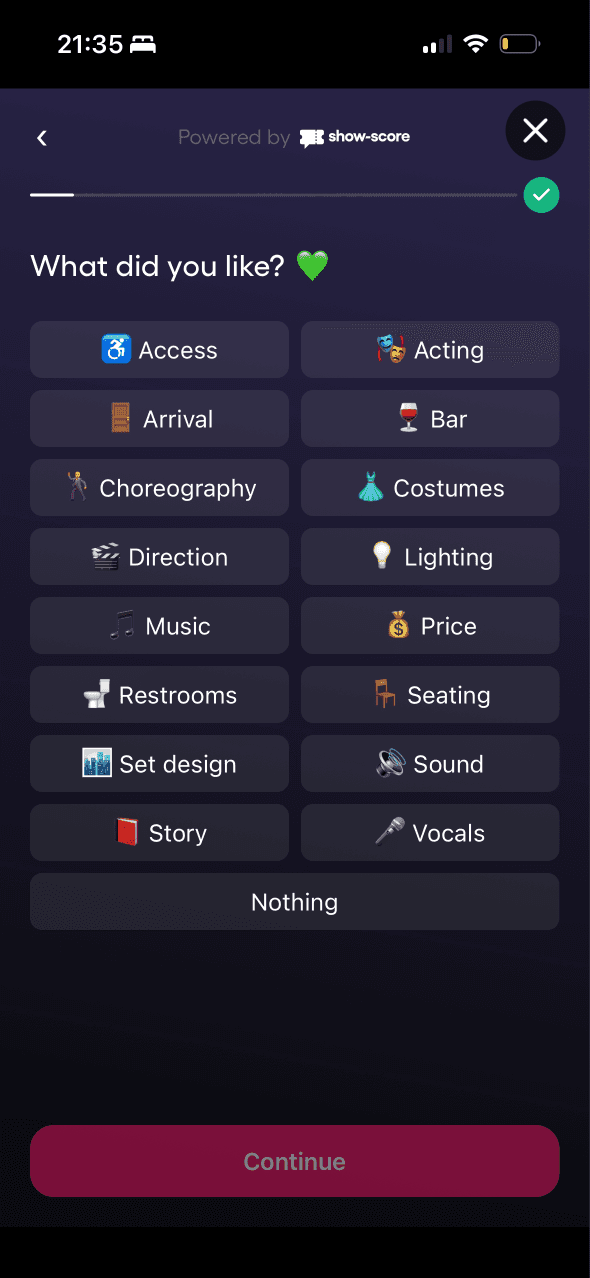
A fixed set of positive aspects supports multiple selection and includes Nothing. The available labels determine which kinds of praise are easiest to express.
Short labels and icons let people recognise aspects of the experience rather than compose them from memory. Familiarity does not guarantee that the options cover their view.
Positive aspects are asked before negative ones, making favourable categories active early in the survey. Any effect on later responses would need comparative evidence.
Show 1 more principleShow fewer principles
Collecting positive aspects separately creates a clear comparison point for the negative-aspect screen that follows, rather than compressing both into one score.
If Show-Score uses choice architecture and priming to explain how selected tags shape later questions and the public review, then people should answer more deliberately because the downstream effect is visible.
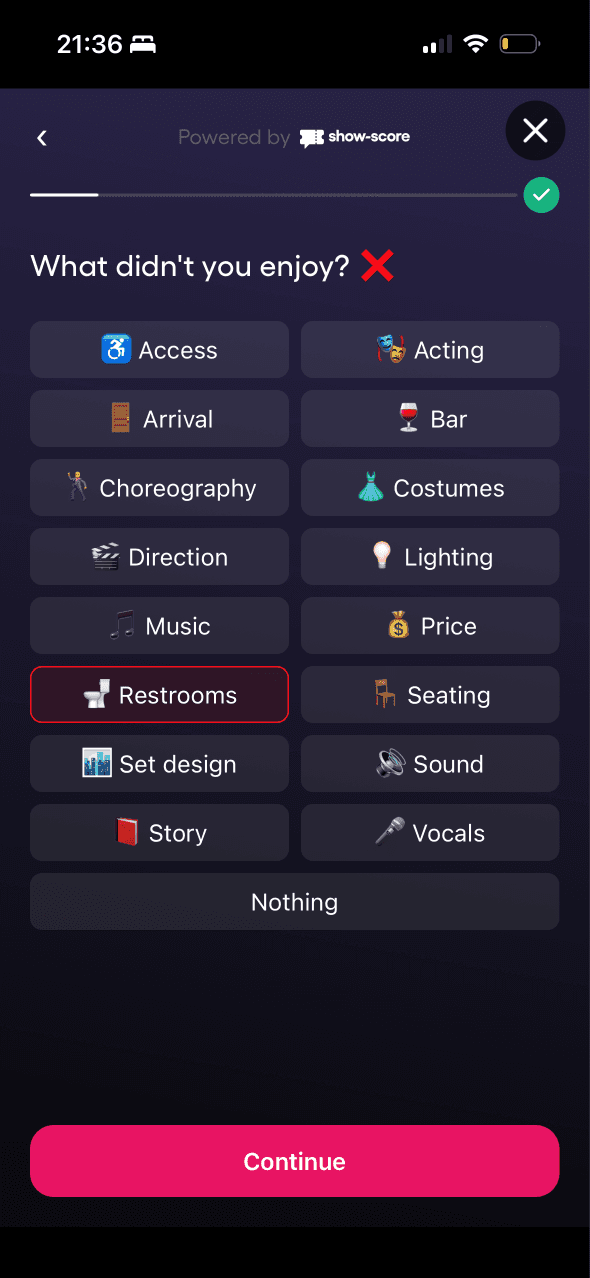
Screen 04
What didn’t you like?
The question explicitly asks what was not enjoyed and presents a set of problem categories. This frames the task around faults while preserving a neutral Nothing route.
Selectable tags make several negative explanations easy to report. The set may still constrain answers or combine venue and production problems that need different owners.
Placing negative aspects immediately after positive ones makes the two lists easy to compare, but the mirrored sequence may encourage respondents to balance answers rather than report them independently.
Show 1 more principleShow fewer principles
The positive categories shown one step earlier remain active when the negative list appears, which can shape what problems come to mind first.
If Show-Score uses framing and contrast to separate venue, production and price issues while preserving Nothing and an open answer, then people should give more actionable criticism because the cause is easier to identify.
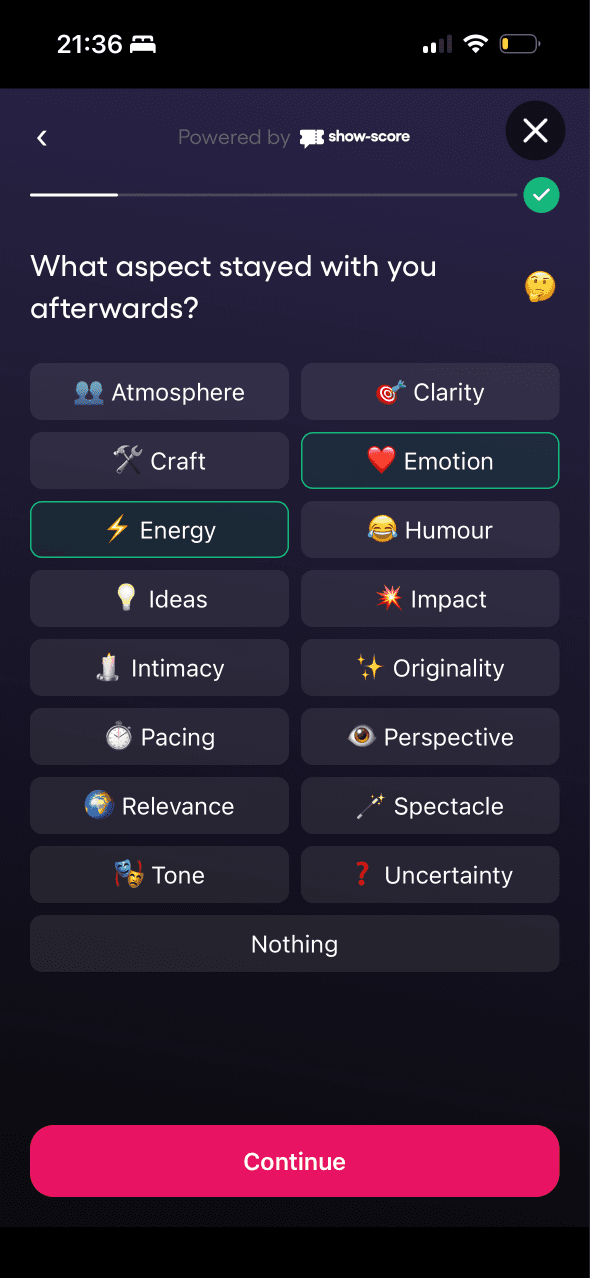
Screen 05
What stayed with you?
The question asks people to identify what remained most mentally prominent after the show. Selected labels are reported memories, not proof of what originally captured attention.
Named aspects such as emotion, humour and pacing provide cues for recognising an experience. The list may also make unlisted memories less easy to express.
Multiple selectable aspects and a Nothing option structure how a memorable moment can be described. No open alternative is visible in the captured screen.
Show 1 more principleShow fewer principles
Asking what stayed with someone after separate like and dislike prompts may favour the most intense or recent parts of the show over a fuller account of the experience.
If Show-Score combines salience with recognition while allowing an open memory, then people should report what genuinely stood out because the supplied categories do not define the answer for them.
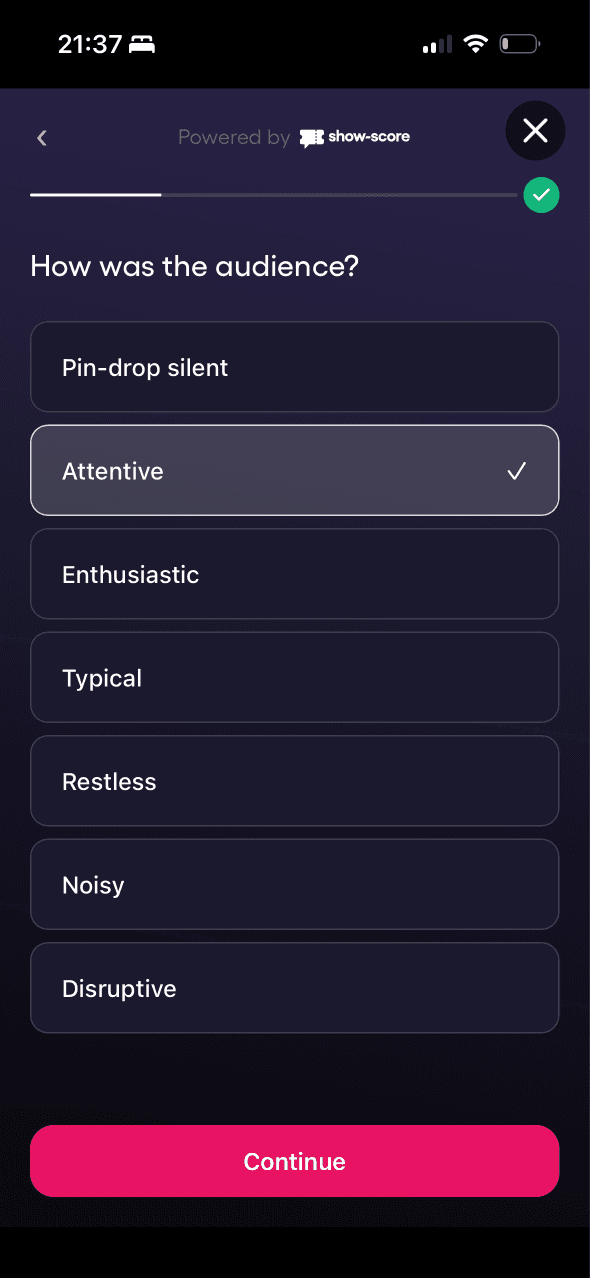
Screen 06
How was the audience?
One focused audience question appears with back, close and progress controls, preserving the same simple interaction pattern used across the survey.
The audience is reduced to labels ranging from attentive to disruptive. Those terms frame a subjective impression as a single overall classification.
One option appears selectable from a fixed vertical list. Without mixed or unsure choices, the structure may force a cleaner judgement than the experience supports.
Show 1 more principleShow fewer principles
Ordered labels invite comparison between increasingly negative audience descriptions. Their sequence may influence where an ambiguous experience is placed, although that requires testing.
If Show-Score uses framing and choice architecture to include mixed and unsure audience judgements, then people should report the experience more fairly because they are not forced into one absolute label.
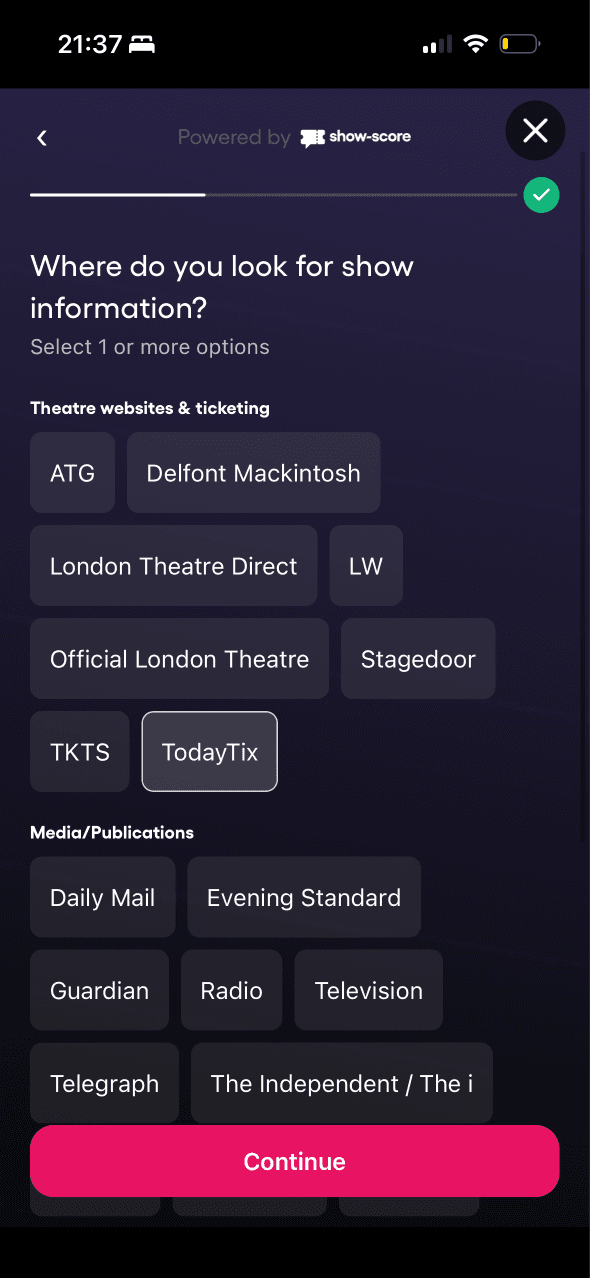
Screen 07
Where did you hear about it?
This question follows several easy review choices and expands the task into acquisition research, making the larger request arrive only after the respondent is already engaged.
Named ticketing, theatre and media sources are grouped into selectable options. Their selection and ordering determine which attribution routes are easiest to report.
Recognisable brand names reduce the need to recall a source unaided. The list may still omit informal discovery routes or encourage selection of familiar names.
Show 1 more principleShow fewer principles
A long list of ticketing and media brands makes those channels prominent before later questions about motivation and purchase barriers.
If Show-Score uses choice architecture and the foot-in-the-door pattern responsibly by announcing the move into marketing research, then people should answer with greater trust because the new purpose is explicit.
Screen 08
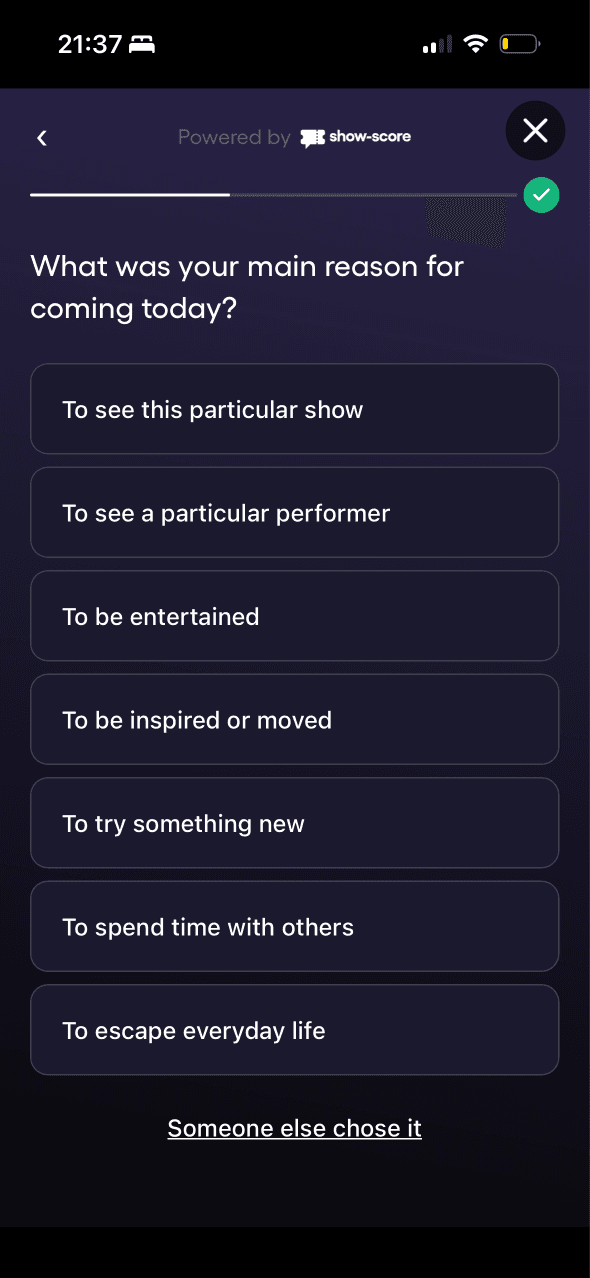
Why did you go?
The list covers show, performer, entertainment, inspiration, social and escape motives, with Someone else chose it preserving a useful alternative to personal intention.
Reasons are phrased around show, performer, entertainment, inspiration and social or escape goals. Those frames shape how people interpret and report their visit.
Asking for a main reason invites a coherent account of a past choice. The answer may reflect present self-description rather than the complete cause of attendance.
Show 1 more principleShow fewer principles
Choosing a main reason immediately before purchase-barrier questions can make the selected motivation the lens through which later answers are explained.
If Show-Score uses choice architecture and self-consistency carefully by allowing several reasons and an open answer, then the research should capture mixed motivations because people are not asked to produce one tidy story.
Screen 09
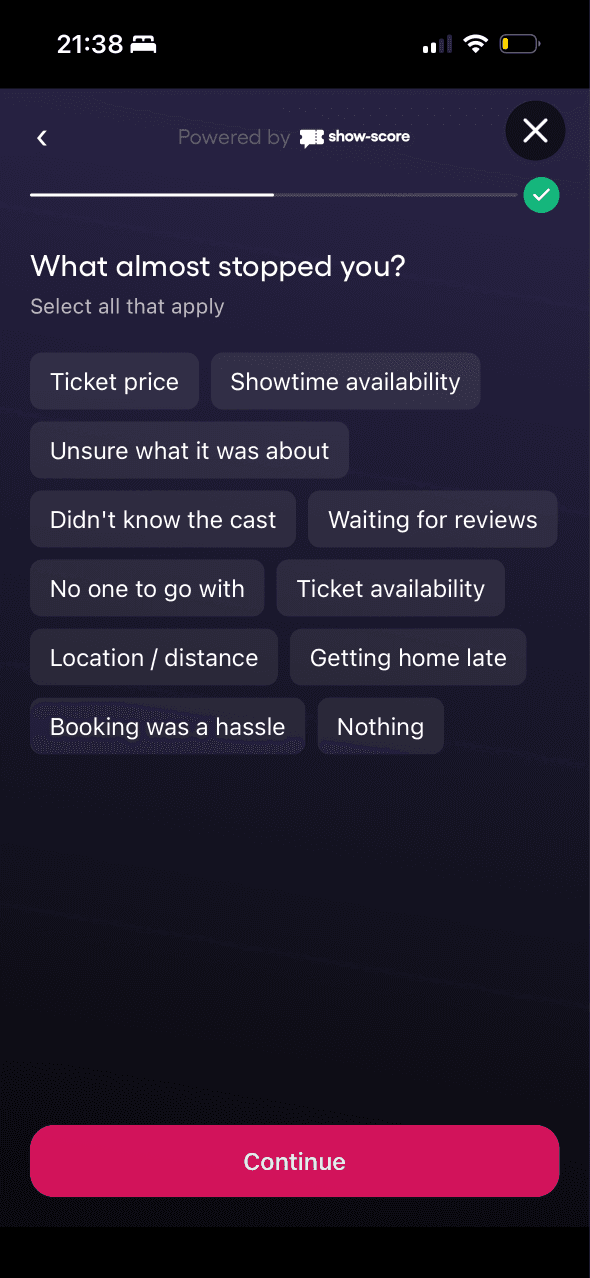
What almost stopped you?
A multi-select list makes price, availability, uncertainty and logistics easy to report. The categories also define which barriers are most visible to respondents.
Options such as not knowing the cast, waiting for reviews and being unsure what it was about describe ways people may avoid a choice they could later regret.
Several answers describe wanting more cast, story or review information before purchase, but the survey risks treating more information as the solution without testing whether it improves the decision.
Show 1 more principleShow fewer principles
Putting ticket price first in the barrier list makes cost especially available just before the dedicated price-perception question.
If Show-Score combines choice architecture with information-bias awareness by allowing multiple barriers and an open reason, then the research should reflect the purchase context better because uncertainty is not reduced to one cause.
Screen 10
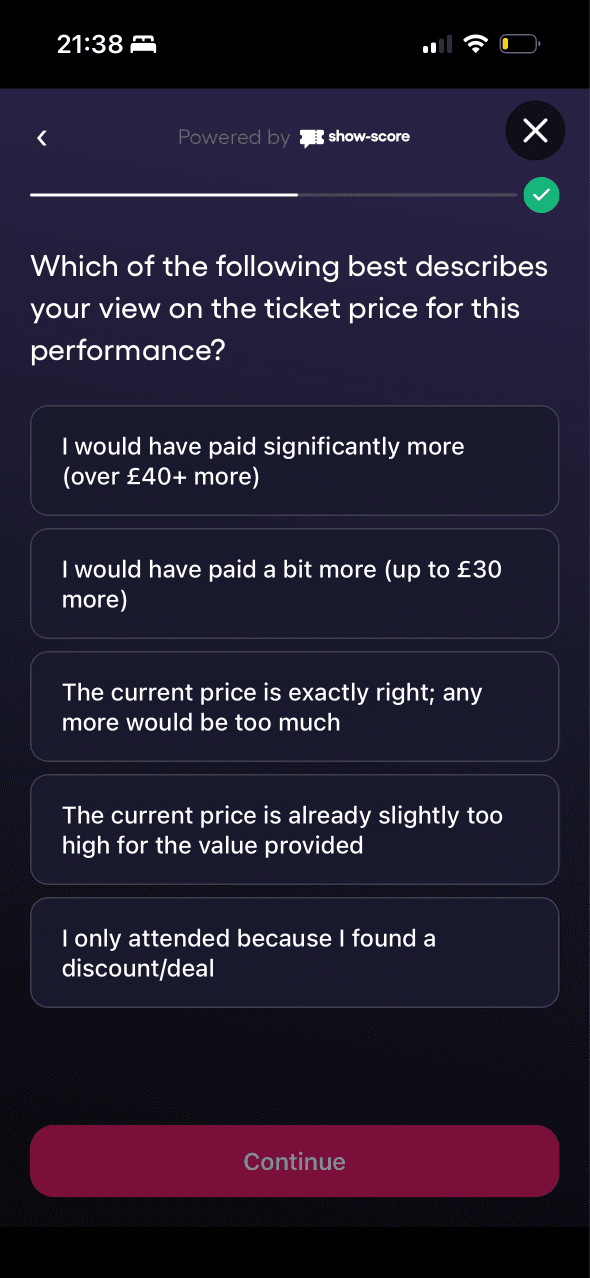
Was the price right?
Large, mutually exclusive statements make the price question easy to scan and include both higher willingness to pay and an explicit too-expensive response.
The £40 and £30 higher-price options provide numerical reference points before the respondent judges the ticket, which can make later amounts feel high or low by comparison.
The options frame the same ticket as a bargain, exactly right or too expensive. Those verbal categories combine value judgement with hypothetical willingness to pay.
Show 1 more principleShow fewer principles
Respondents compare the current price with several higher-price scenarios and a discount explanation. Seat quality and total fees are not present in that comparison.
If Show-Score uses anchoring and framing with the amount paid, seat quality, discount and fees visible, then the result should represent value more accurately because hypothetical price bands are grounded in the purchase.
Screen 11
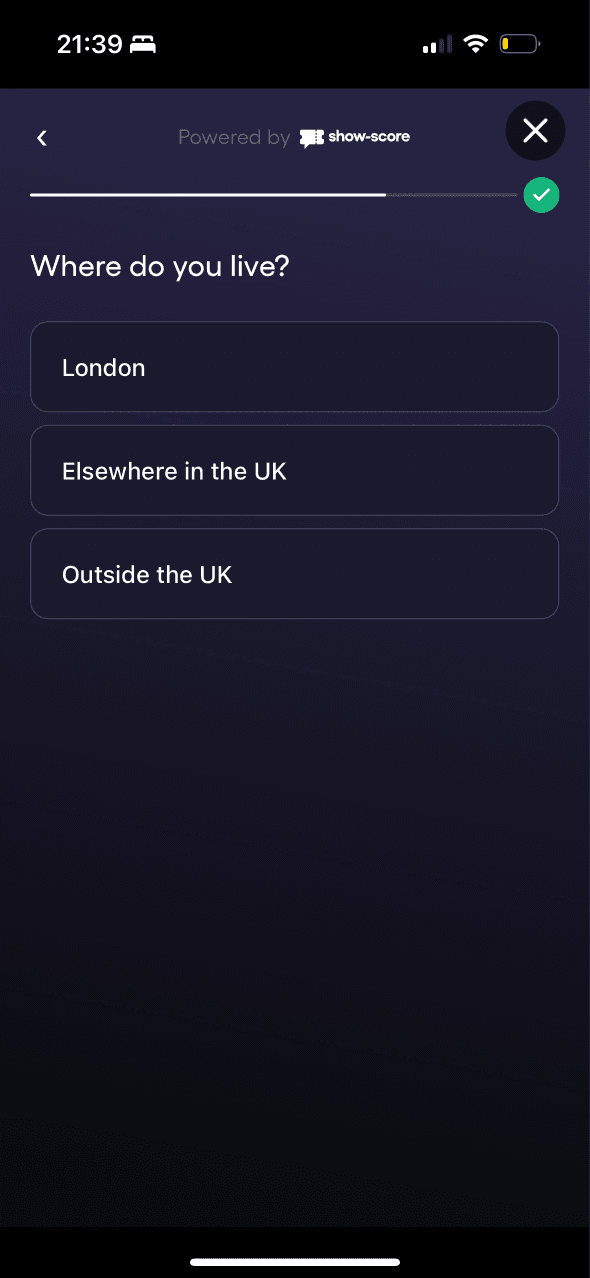
Where do you live?
Three broad regions keep the location choice quick and avoid asking for precise address data, limiting both response effort and unnecessary detail.
A personal location question arrives after a sequence of low-effort show questions. The gradual expansion is visible, but it does not prove that earlier answers cause later disclosure.
Three broad regions make the answer quick, but there is no visible Prefer not to say option. The categories reduce precision while still requesting personal information.
Show 1 more principleShow fewer principles
The survey introduces location only when it reaches that topic rather than upfront. Just-in-time presentation should still include just-in-time purpose and privacy information.
If Show-Score uses progressive disclosure and the foot-in-the-door pattern responsibly by making location optional and explaining its use, then people should make a more informed privacy choice because the new data request is justified.
Screen 12
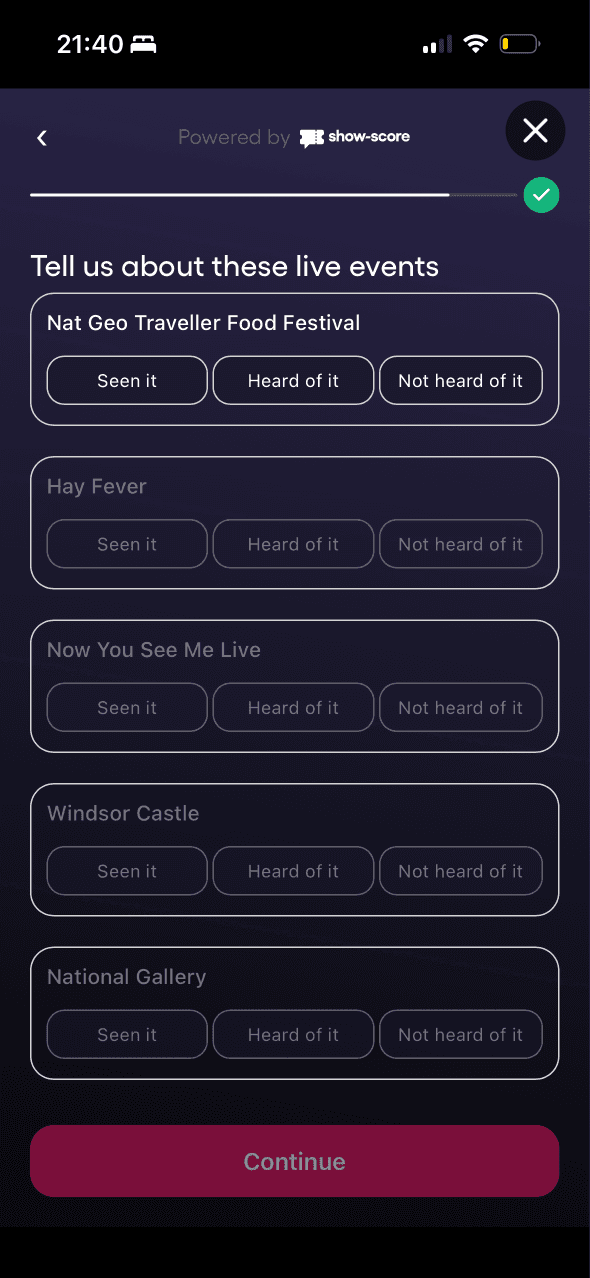
Other live events
A sequence of event names creates repeated exposure within the survey, which can increase familiarity even when the stated task is only to report prior awareness.
Seen it, Heard of it and Not heard of it let people report recognition without recalling details. Recognition should not be treated as interest or purchase intent.
Every event uses the same three response categories, making comparison consistent. The list’s selection and order still shape what the research can observe.
Show 2 more principlesShow fewer principles
The event list introduces a wider entertainment frame immediately before the performer-interest question, moving attention further away from the original show review.
Presenting unrelated events inside the same review journey frames general market awareness as a natural extension of rating one attended show.
If Show-Score balances mere exposure with neutral framing and a clear research handover, then people should understand why unrelated events appear because awareness is not presented as interest.
Screen 13
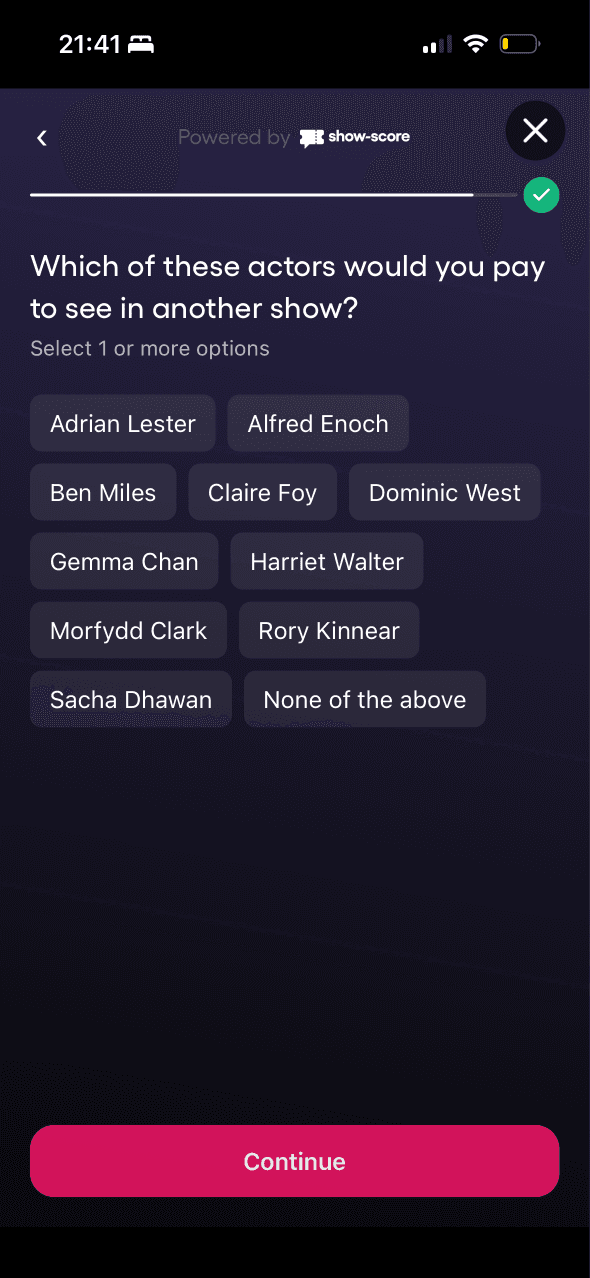
Performers you would see
A list of actor names lets respondents recognise performers they would pay to see. Recognition may depend on name familiarity rather than a stable ticket preference.
Multiple names and None of the above define the available preference set. The absence of an open alternative limits expression beyond the selected cast.
Showing a group of performer names adds another exposure to each person, which can build familiarity even when a respondent selects None of the above.
Show 1 more principleShow fewer principles
The wording asks who someone would pay to see, framing performer interest through spending rather than simple familiarity, enjoyment or curiosity.
If Show-Score uses recognition and framing to explain whether performer choices affect recommendations or marketing, then people should state preferences more knowingly because the future use of the answer is clear.
Screen 14
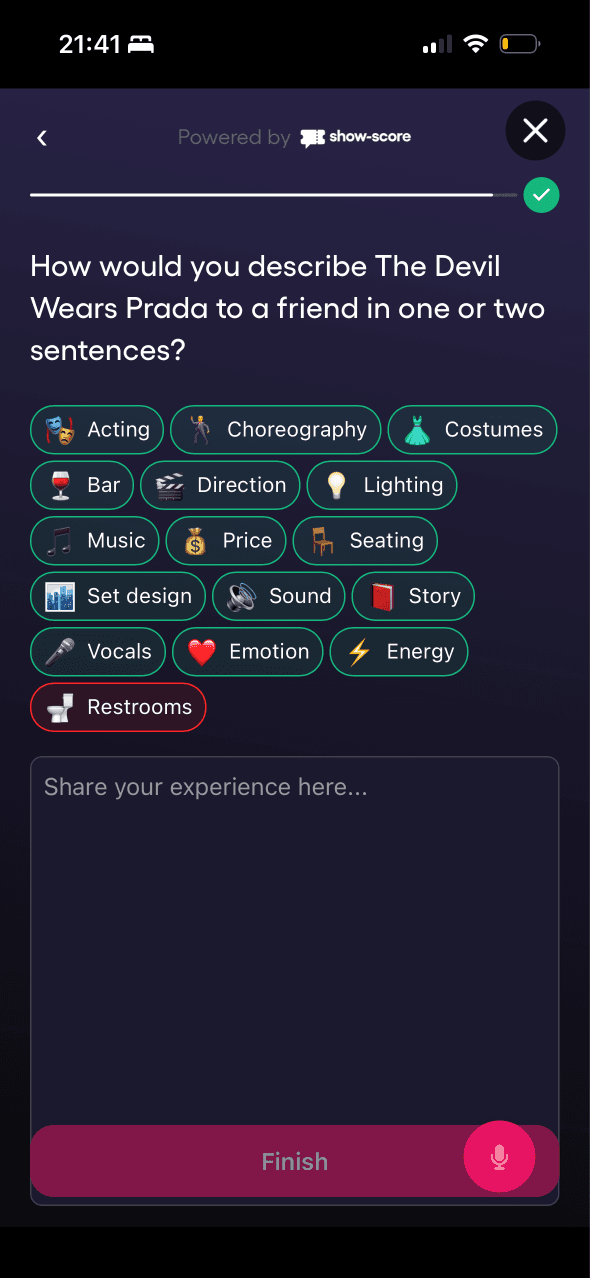
Write your review
Previously selected positive, negative and memorable tags appear above the writing field. They may cue what comes to mind, but their effect on the final text requires comparison.
Carried-forward choices encourage the written review to align with earlier answers. Consistency can aid recall while also making it harder to revise an initial judgement.
Free text appears after structured questions, when the person has already assembled several reflections. The sequence supports composition but also makes the review the end of a long task.
Show 1 more principleShow fewer principles
The writing task comes near the end of a long survey, so the most recent research questions may influence the final account more than the show experience itself.
If Show-Score uses priming and self-consistency transparently by letting people edit carried-forward tags, then the final review should reflect their considered view because earlier answers remain reversible.
Screen 15
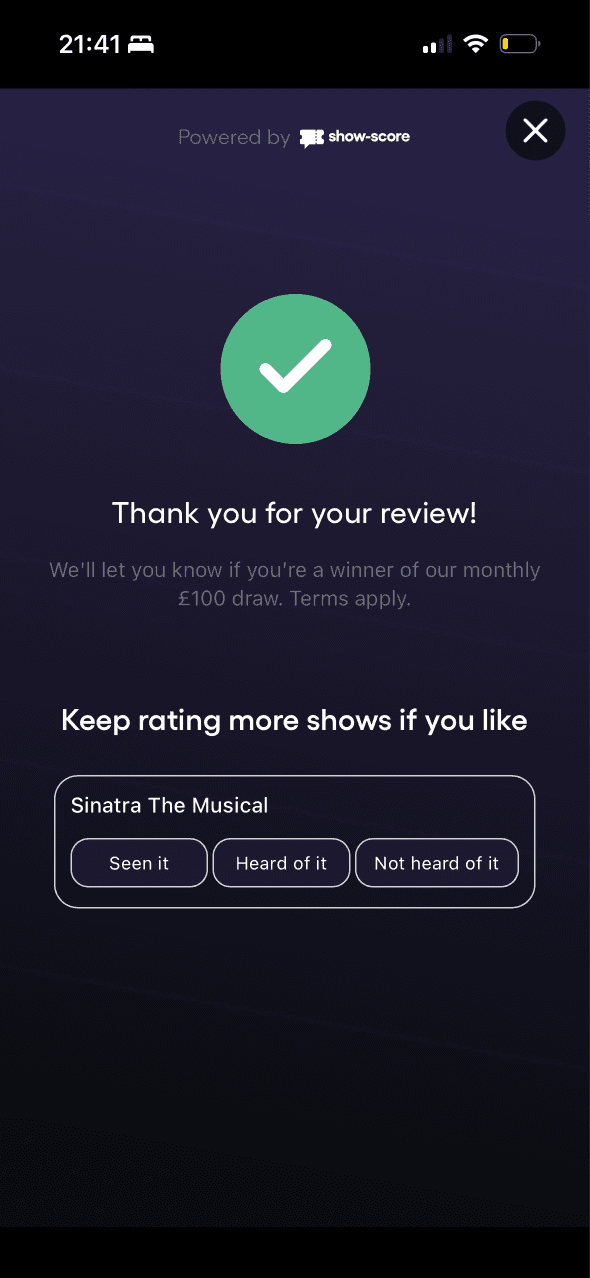
Review submitted
A large checkmark and thank-you message confirm that the review was submitted. This gives a clear end state after a long sequence of questions.
The final screen pairs successful completion with another optional rating task. This ending may colour recall of the journey, but its effect on satisfaction is not demonstrated.
A request to rate another show follows immediately after completion. The sequence creates a smaller follow-on ask, although continued participation cannot be inferred from the image.
Show 1 more principleShow fewer principles
The completed progress line and large checkmark make arrival at the end unmistakable after a long sequence of small steps.
If Show-Score combines feedback with the peak-end rule by making confirmation dominant and further ratings clearly optional, then people should leave with a clearer sense of completion because the original task ends before another begins.
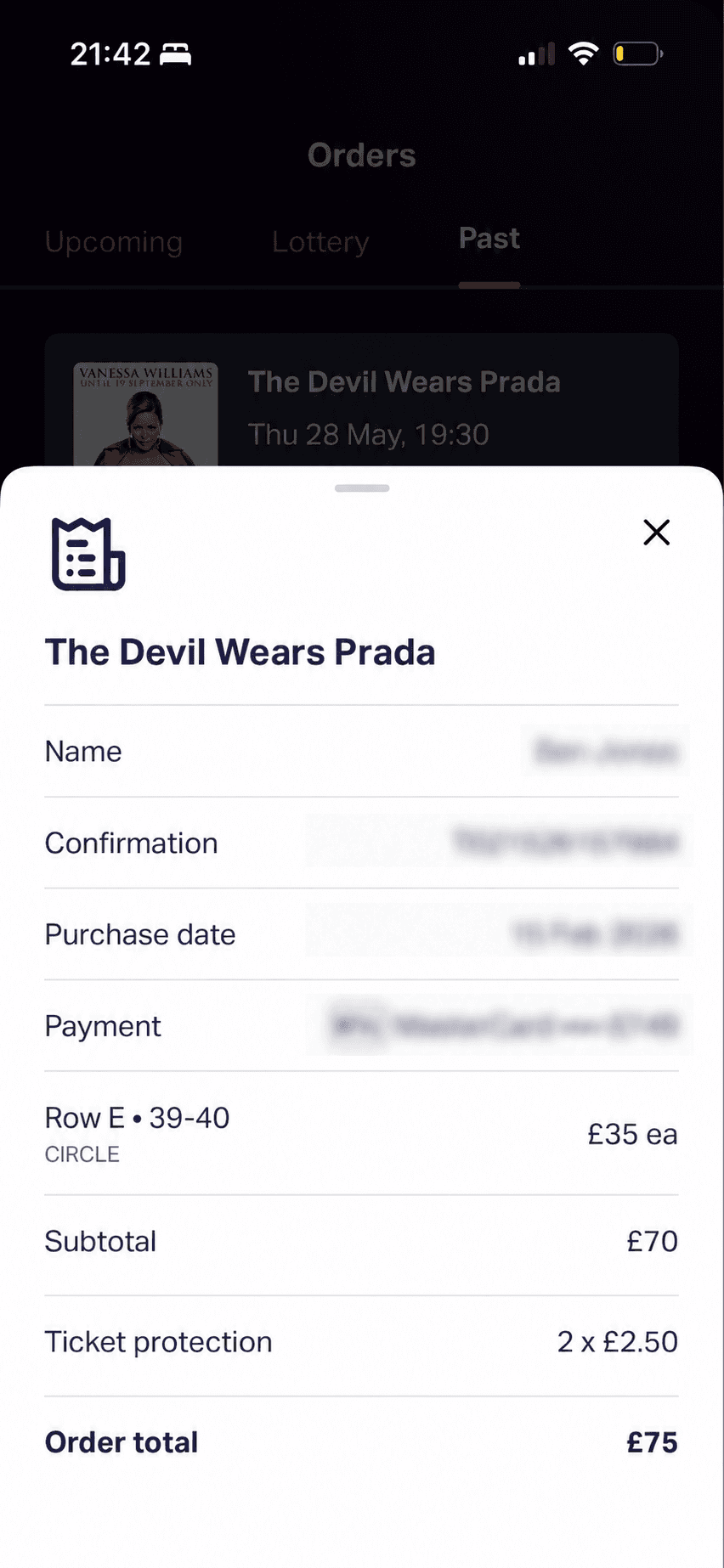
Screen 16
Order receipt
Opening a full receipt from the review entry point can expose more account and payment detail than the rating task needs, especially in a shareable or observed context.
A receipt opens over the order list and reveals detailed purchase information on demand. The pattern keeps the list compact while making verification available.
Confirmation, purchase date, seat, subtotal, protection and total provide a durable record of the completed transaction. Accuracy and accessible labelling are essential.
Show 1 more principleShow fewer principles
The order total is visually stronger than most receipt rows, helping people locate the final charge. Personal and payment information should remain protected in any shared context.
If TodayTix uses progressive disclosure and feedback to show only the purchase details needed for verification, then people should confirm the order safely because sensitive information stays protected.
Conclusion
What this journey teaches us.
The individual questions are not especially difficult. The problem is the gap between the task people agree to and the task they are eventually asked to complete. A review, a prize draw and commercial research can sit in one journey, but each needs a clear purpose and a genuine choice.
A better version would preview the scope, mark optional questions and ask again before moving beyond the public review. That would protect trust and should produce cleaner research data because people would understand what they are contributing.
Keep exploring