
Information Bias
Seeking an answer even when none of its possible results would change what you do.
In one sentence
In decision psychology, information bias means valuing or seeking a question, test or extra fact even when no possible answer would change the action you should take. It is not simply a screen containing lots of information, and it is different from “information bias” in research methods, where data can be measured or recorded inaccurately.
Try this in practice
Make the idea useful.
Use these as hypotheses to test in your own product and context—not as predictions about what people will do.
- Define the decision before deciding what information to show or request. For each field, filter, disclosure or research question, write down what action could change for each possible answer. Keep information that supports informed consent, safety, accessibility or later decisions even when it does not change the immediate click.
- Do not confuse information bias with information overload. A long page is not evidence of the bias, and a short page is not automatically better. Distinguish required evidence, optional explanation and genuinely non-decision-changing detail; let people inspect more without making completion, reassurance or curiosity feel mandatory.
- Test the decision, not just the amount of content. Ask people which information changed their choice and why; compare decision accuracy, confidence calibration, time, abandonment and later regret. Stop or revise the design if it hides material facts, pushes premature action, or makes users treat an irrelevant answer as a reason to choose differently.
- Use it when
- Recognising the pattern helps teams separate information that can change a decision from detail that only feels reassuring, complete or interesting.
- Watch for
- Extra searching can delay action, add cost and give irrelevant detail too much weight. But removing information by default can also harm understanding, accessibility or informed consent: the test is whether it can change this decision for this user, not whether the interface looks minimal.
Seen in real products
How teams put it to work.
Examples identified in our interface teardowns, linked back to the full product journey.
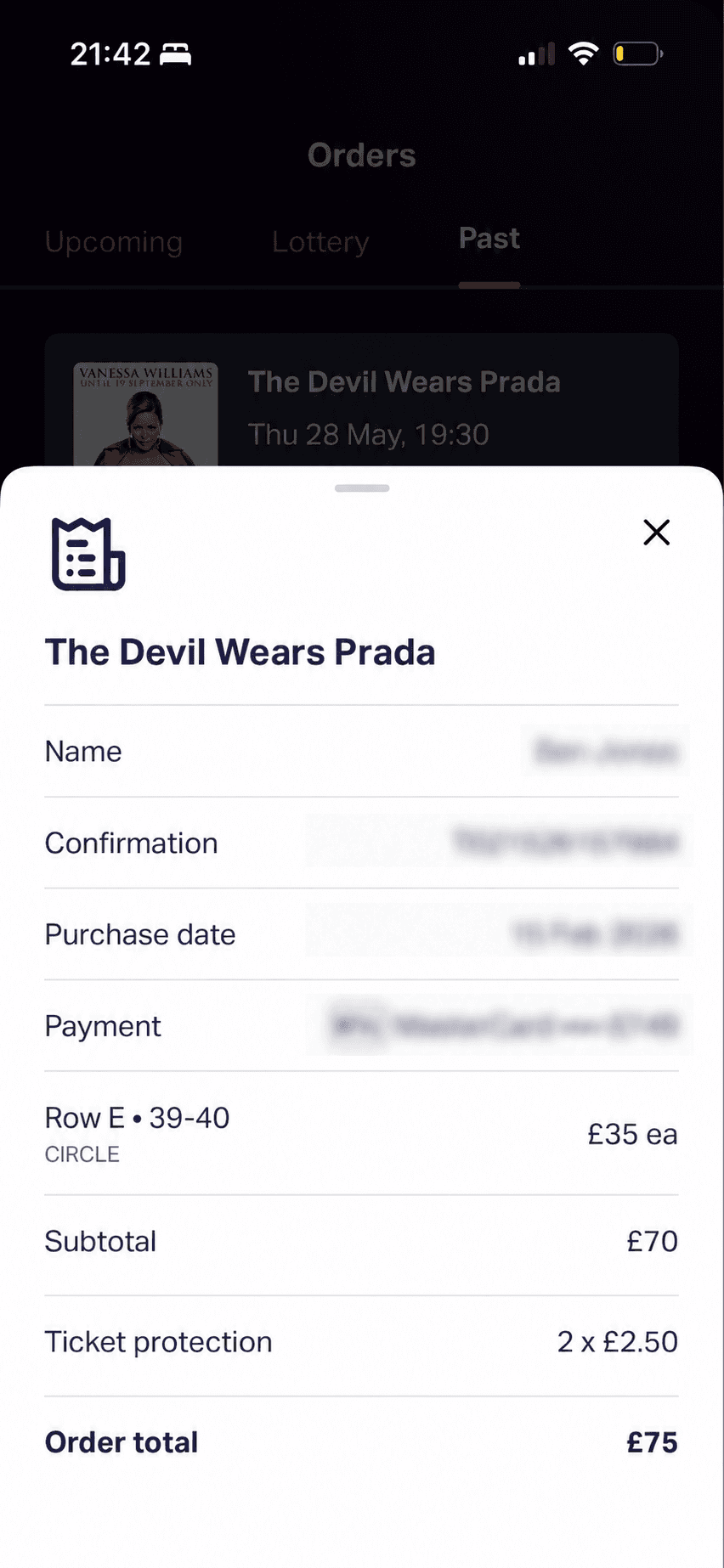
Opening a full receipt from the review entry point can expose more account and payment detail than the rating task needs, especially in a shareable or observed context.
View Ask for feedback without overreaching →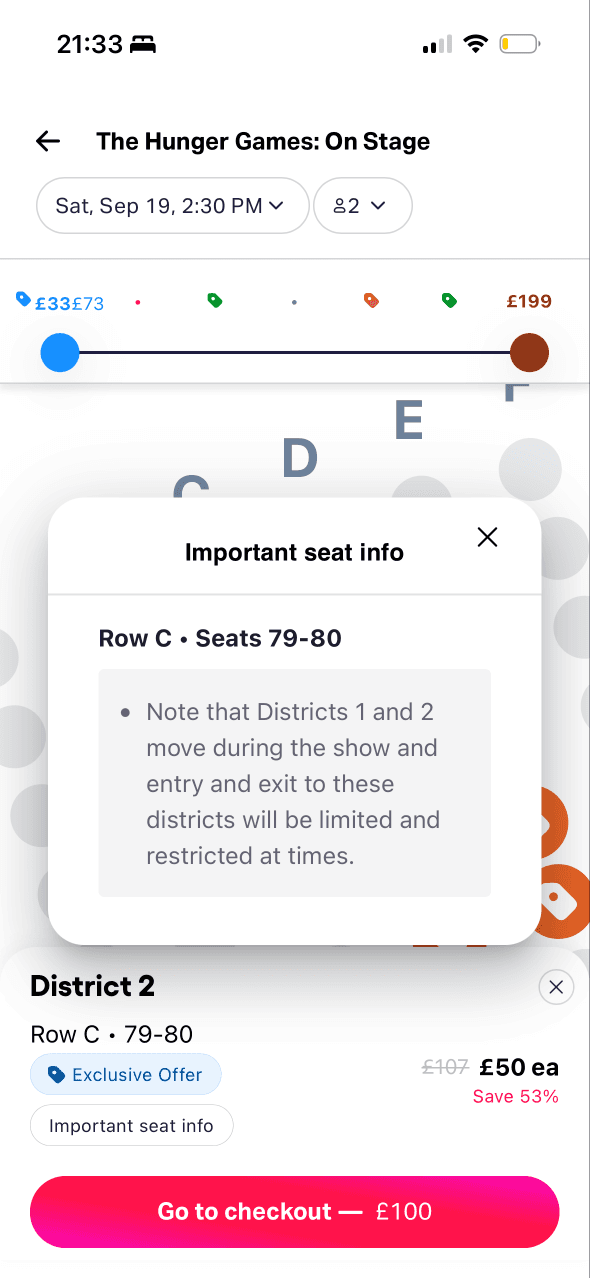
Extra detail about limited views and movement is useful for judging suitability. Requiring acknowledgement should depend on consequence, not an assumption that more information is always better.
View Make seat choice feel safe →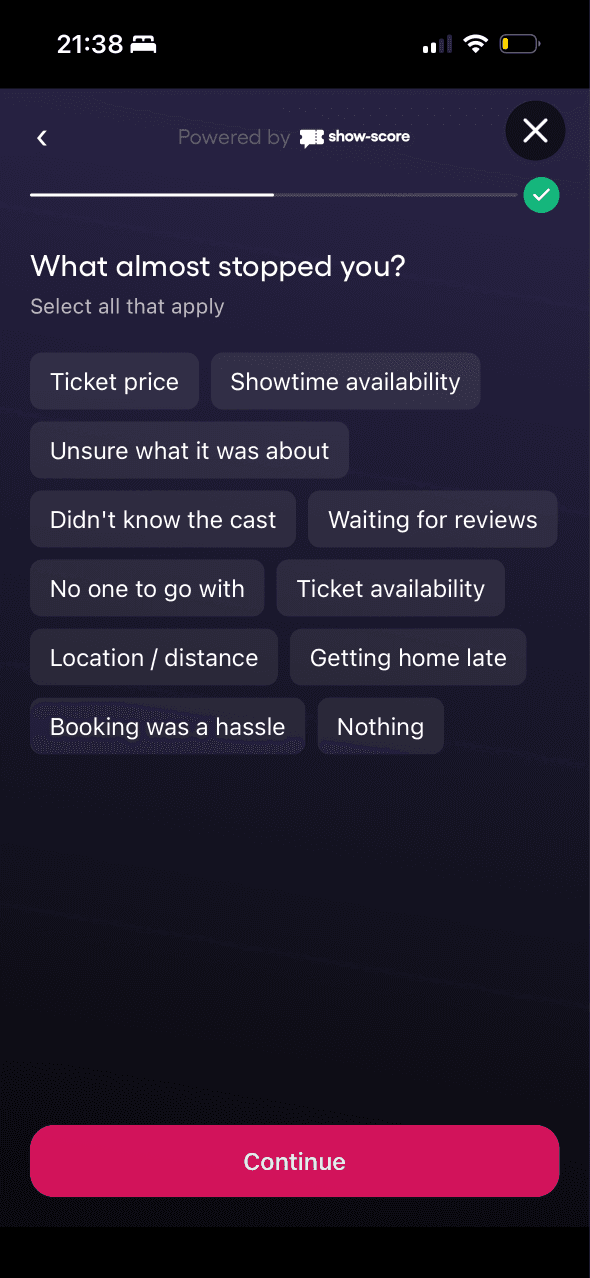
Several answers describe wanting more cast, story or review information before purchase, but the survey risks treating more information as the solution without testing whether it improves the decision.
View Ask for feedback without overreaching →Current interpretation
What this may help explain.
Jonathan Baron, Jane Beattie and John Hershey reported six experiments in 1988 on how people value yes-or-no questions when choosing which hypothesis to act on. Their definition was precise: a question has no decision value when every possible answer leaves the same action as the best choice. In Experiment 4, 12 analysed participants rated ten fictional medical tests from 0 (worthless) to 100. Only two tests could improve which of three diseases would be treated; the other eight could change confidence or distinguish alternatives without changing treatment.
Participants did recognise the two useful tests as the most valuable, but they still gave positive average ratings to many tests with zero decision value. Tests that supplied information about diseases that would never be treated were rated above a matched uninformative test, and tests that changed confidence without changing treatment were also overvalued. The authors found the same failure to check whether an answer could change action in each of their first four experiments, although many participants avoided it or corrected themselves when prompted. A 1998 series extended the pattern to hypothetical course, mortgage, purchase and strategic decisions: for example, 56% of 149 students waited to learn who would teach a course even though 82% of a separate 140-person group would enrol when given the less favourable answer up front. In a 2017 reuse of one medical vignette, 71% of 173 superforecasters, 63% of 75 other forecasters and 38% of 92 undergraduates correctly rejected the useless test, showing substantial variation rather than a universal response.
Use this as a starting point for a hypothesis, then check it with your own users and context.
Source check
What this guidance is based on.
3 sources have been checked by The UXologist. Findings and limitations are shown together so you can judge how well they fit your situation.
How Generalizable Is Good Judgment? A Multi-task, Multi-benchmark Study
Research-assisted source review
- What it supports
- The useless test was correctly rejected by 71% of superforecasters, 63% of regular forecasters and 38% of undergraduates. Superforecasters and regular forecasters did not differ significantly on this item, while superforecasters outperformed undergraduates.
- Who or what was studied
- The first online survey included 173 superforecasters, 75 other geopolitical forecasters and 92 University of Pennsylvania undergraduates. Forecasters averaged 37.1 years old and held at least a bachelor's degree; undergraduates averaged 19.7 years.
- Study setting
- A multi-task survey compared judgment skills across groups. Its information-bias measure reused one fictional medical vignette from Baron, Beattie and Hershey: participants decided whether to run a test whose result could not change which disease should be treated.
- Where it may not transfer
- Information bias was measured with one binary vignette inside a broader survey, so it offers a limited replication rather than a general prevalence estimate. The selected forecasting groups differed in education, experience, training, motivation and teamwork; the study does not isolate which factor explains the group difference or establish behaviour in real product decisions.
On the Pursuit and Misuse of Useless Information
Research-assisted source review
- What it supports
- People often waited for information that would not have altered their choice if it had been available initially, then gave the obtained answer more weight. In the course scenario, 82% enrolled when told up front that the less popular professor would teach, but 56% of the uncertain group waited; after receiving that same answer, 27 percentage points of the full uncertain group declined.
- Who or what was studied
- Paid undergraduate volunteers from Princeton University and Stanford University took part in several between-group hypothetical-choice studies; sample sizes differed by scenario. The course study included 140 participants in the known-information condition and 149 in the uncertain condition.
- Study setting
- Across social, consumer and strategic scenarios, one group chose with information already known while another could wait for the same missing information. Those who waited then received an answer that made the final scenario identical, allowing the researchers to compare whether pursuing the information changed the choice.
- Where it may not transfer
- These were hypothetical decisions among students, often with low or simplified costs. Noninstrumental was inferred by comparing separate groups rather than established for every individual. The work concerns pursuing and then using missing information, which is related to but not identical to every kind of information-rich interface.
Heuristics and Biases in Diagnostic Reasoning II: Congruence, Information, and Certainty
Research-assisted source review
- What it supports
- Participants overvalued questions that could change confidence in the favoured hypothesis or distinguish alternatives that would not be acted on. In Experiment 4, only two of ten tests had positive normative value, yet many zero-value tests received positive mean ratings. The failure to consider whether results could change action appeared in Experiments 1 through 4, while interviews showed that some participants could recognise the issue when prompted.
- Who or what was studied
- Six experiments used mostly student participants. Experiment 4 analysed 12 participants after excluding two who did not use the requested rating task; two additional interview problems were given to 33 participants.
- Study setting
- Participants evaluated yes-or-no questions or fictional medical tests. A normative model treated a question as worthless when no possible answer could change which hypothesis should be accepted for action. Experiment 4 supplied priors and conditional probabilities for three fictional diseases and asked participants to rate ten tests from 0 to 100.
- Where it may not transfer
- The samples were small and drawn largely from university students, the tasks used fictional diseases and supplied probabilities, and the normative result depended on the stated goal of choosing one immediate treatment. Real decisions may have multiple actions, learning value, emotional value, legal duties or future uses for information that the task excluded.