
Recognition Heuristic
When one of two options is recognised, people may use recognition as a clue—but only when it predicts what is being judged.
In one sentence
The recognition heuristic is a conditional rule for making an inference under uncertainty. If a person recognises one of two objects but not the other, they may infer that the recognised object scores higher on a criterion such as population or popularity. This shortcut can be useful when recognition genuinely correlates with that criterion. It is not a universal preference for familiar things, and familiarity alone is not evidence of quality or suitability.
Try this in practice
Make the idea useful.
Use these as hypotheses to test in your own product and context—not as predictions about what people will do.
- Treat recognition as a clue to investigate, not a ranking signal. If an interface highlights a familiar or popular option, explain the criterion that makes it relevant to the user’s goal.
- Use familiar interaction patterns and plain labels to reduce learning effort, but compare products or recommendations using fit, cost, outcomes and constraints. Keep unfamiliar alternatives equally accessible.
- Test whether recognition actually predicts the intended outcome for each audience. Measure choice quality and exclusion as well as speed, and stop if marketing exposure, geography or cultural familiarity makes unsuitable options look better.
- Use it when
- Helps teams understand how people can make a fast inference from limited knowledge and when a familiar cue may reduce uncertainty.
- Watch for
- Recognition can come from advertising, repeated exposure or cultural access rather than relevance. It can hide better unfamiliar options and disadvantage new, local or less-promoted alternatives.
Seen in real products
How teams put it to work.
Examples identified in our interface teardowns, linked back to the full product journey.

Named themes and illustrated cards let people choose through recognition rather than recalling a specific show. The labels still need to describe a dependable organising idea.
View Help people find the right show →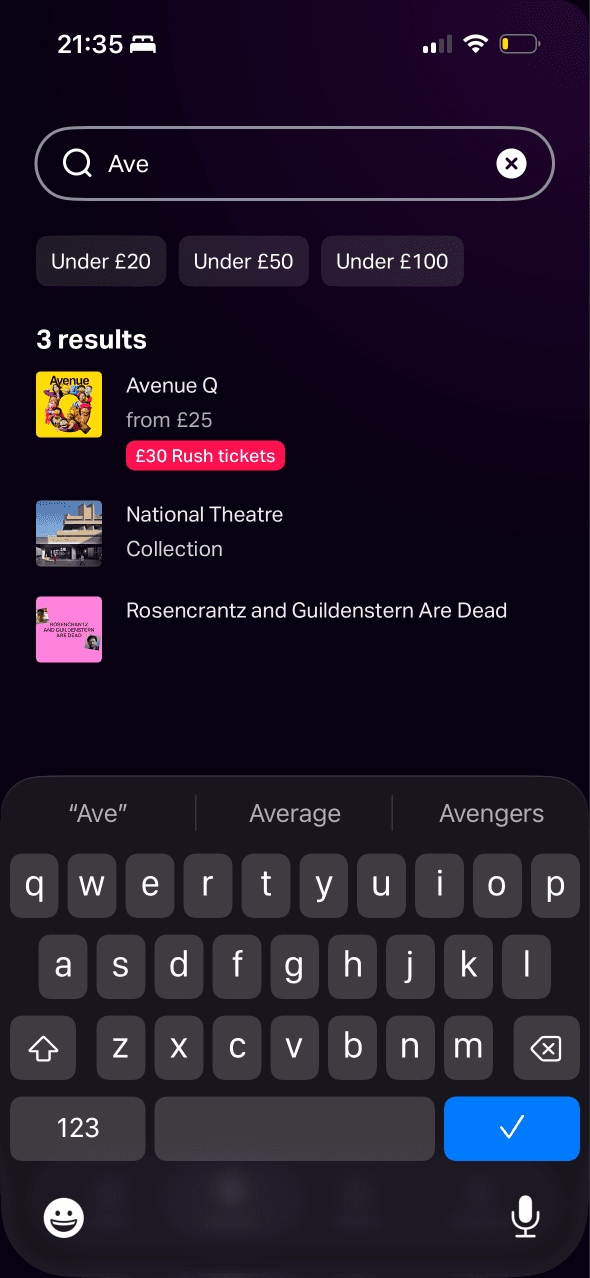
Artwork and partial title matches help people recognise likely destinations as they type. Similar-looking results can still be mistaken when their type is not explicit.
View Help people find the right show →
A list of actor names lets respondents recognise performers they would pay to see. Recognition may depend on name familiarity rather than a stable ticket preference.
View Ask for feedback without overreaching →
Show artwork and familiar category names support recognition while browsing. Familiarity can aid navigation, but it does not establish that a show is relevant or good.
View Help people find the right show →
Short labels and icons let people recognise aspects of the experience rather than compose them from memory. Familiarity does not guarantee that the options cover their view.
View Ask for feedback without overreaching →
Named aspects such as emotion, humour and pacing provide cues for recognising an experience. The list may also make unlisted memories less easy to express.
View Ask for feedback without overreaching →Current interpretation
What this may help explain.
In a 2002 study, 22 University of Chicago students saw every possible pair drawn from either 25 or 30 of Germany’s largest cities. For each pair they chose which city had the larger population, then marked which names they recognised. The researchers examined only comparisons where one city was recognised and the other was not, because those are the cases in which the recognition heuristic makes a prediction.
Across applicable comparisons, participants chose the recognised city on average 90% of the time, with individual rates from 73% to 100%. This showed that recognition strongly predicted their inferences in this task; it did not show that recognition was always correct or that participants preferred the city. In another experiment in the paper, 52 students achieved similar accuracy for US and German city pairs (71.1% versus 71.4%) despite knowing more about US cities. Later evidence is more qualified: four experiments published in 2006 found that further knowledge could compensate for recognition and that “less is more” effects were absent or small. A 2011 review concluded that recognition can dominate some judgments, but the conditions for clear less-is-more effects may be uncommon.
Use this as a starting point for a hypothesis, then check it with your own users and context.
Source check
What this guidance is based on.
3 sources have been checked by The UXologist. Findings and limitations are shown together so you can judge how well they fit your situation.
The Recognition Heuristic: A Review of Theory and Tests
Research-assisted source review
- What it supports
- Recognition often has a strong impact and can be adaptive when it correlates with the criterion, but people do not rely on it exclusively. Evidence for less-is-more effects was mixed, and some required conditions appeared uncommon in real settings.
- Who or what was studied
- A review of theoretical and empirical work on recognition validity, recognition-based inference, use of other knowledge and the less-is-more effect across multiple task domains.
- Study setting
- Synthesised studies involving city size, sports outcomes, elections and other inferences, with attention to when recognition is predictive and how individual strategy use varies.
- Where it may not transfer
- This is a narrative research review rather than a meta-analysis with one pooled effect. The reviewed tasks are mostly constrained inference problems, and the authors note unresolved individual differences and incomplete models of how people decide when to switch strategies.
Empirical Tests of the Recognition Heuristic
Research-assisted source review
- What it supports
- Recognised objects were chosen more often when recognition was valid, but participants did not track the validity of their own recognition well. Less-is-more effects were absent or small, and further knowledge could compensate for recognition.
- Who or what was studied
- Participants in four experiments using paired comparisons of cities and other geographical objects.
- Study setting
- Tested whether people chose a recognised object over an unrecognised one when recognition related to the criterion, whether they adapted to recognition validity, whether less knowledge improved accuracy and whether other knowledge could override recognition.
- Where it may not transfer
- The tasks were constrained geographical comparisons and the published abstract does not provide a combined participant count. The findings challenge a strict one-cue account but do not show how recognition will operate in a specific product choice or audience.
Models of Ecological Rationality: The Recognition Heuristic
Research-assisted source review
- What it supports
- In the 22-person experiment, choices followed recognition in an average of 90% of applicable comparisons. In the 52-person comparison, accuracy was similar for US and German cities (71.1% and 71.4%) despite greater knowledge of US cities.
- Who or what was studied
- The paper combines formal modelling, simulations and several experiments. One experiment used 22 University of Chicago students; another used 52 students from the same university.
- Study setting
- Participants inferred which of two cities was more populous and reported which names they recognised. The design compared cases where exactly one city was recognised and also tested US versus German city domains.
- Where it may not transfer
- The experiments used small student samples and repeated pairwise city-population judgments. Some claims also depend on formal assumptions and simulations. Recognition was a useful cue in these environments; the findings do not establish a universal preference for familiar products or show that recognition always predicts quality.